The basketball rim in the NBA is 10 feet from the surface of the court. This height is a fundamental aspect of the game, dictating much of the strategy, athleticism, and skill required to play professionally.
For anyone who has ever watched an NBA game, or even just picked up a basketball, the image of players soaring to the hoop to slam-dunk or shoot a graceful jump shot is iconic. But have you ever stopped to wonder about the precise measurements that make these feats possible? The height of the basketball rim isn’t just an arbitrary number; it’s a carefully established regulation that has remained consistent throughout much of the sport’s history. This article will delve into the specifics of the NBA basketball rim height, explore its historical context, and discuss how this measurement impacts the game. We will cover the NBA basketball hoop height, the standard basketball rim height, regulation basketball hoop specifications, and the official basketball rim size.
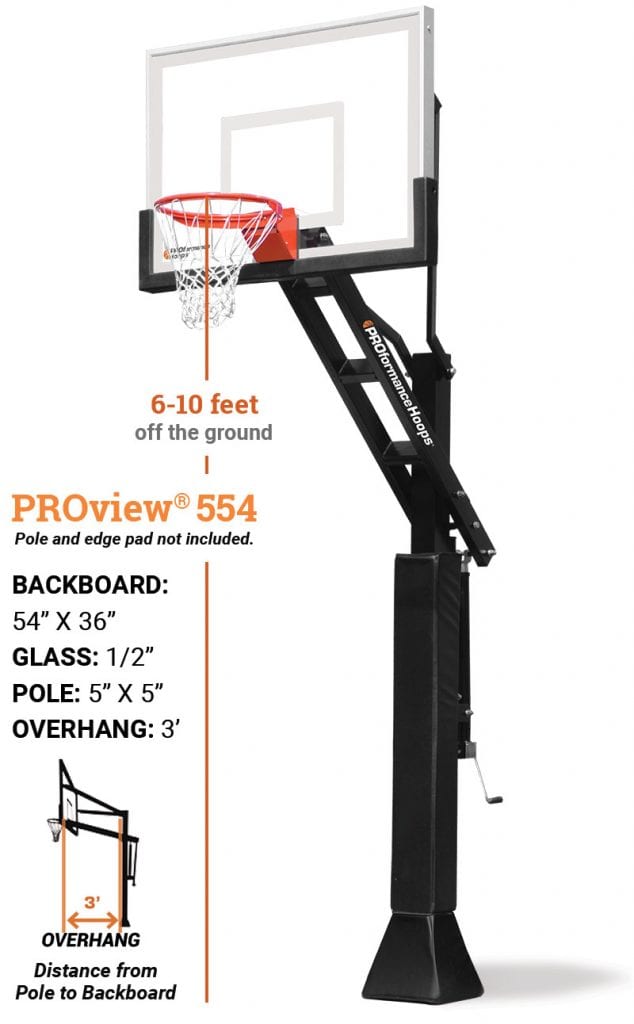
Image Source: superiorplay.com
Deciphering the NBA Basketball Hoop Height
The NBA basketball hoop height is uniformly set at 10 feet (approximately 3.05 meters) above the court floor. This measurement applies to all professional NBA games played on regulation courts. It’s a crucial detail for understanding the game’s dynamics. Whether it’s a towering center performing a sky-hook or a guard driving for a layup, every player operates within the confines of this 10-foot challenge.
The Standard Basketball Rim Height: A Global Benchmark
While we are focusing on the NBA, it’s important to note that the standard basketball rim height of 10 feet is not exclusive to professional basketball. This measurement is also the standard for most organized basketball leagues worldwide, including FIBA (International Basketball Federation) and NCAA (National Collegiate Athletic Association). This global consistency ensures that players transitioning between different leagues and international competitions face the same fundamental challenge. This uniformity is vital for player development and fair competition.
Regulation Basketball Hoop: More Than Just Height
A regulation basketball hoop involves more than just its height. It includes specific dimensions for the backboard, rim, and net.
* Backboard: The backboard is typically rectangular, measuring 6 feet wide by 3.5 feet high (approximately 1.83 meters by 1.07 meters). While some professional courts may have slightly different backboard dimensions for aesthetic or branding purposes, the functional height of the rim remains paramount.
* Rim: The rim itself is a circular steel ring with an inner diameter of 18 inches (approximately 45.7 cm). It must be able to withstand the force of a dunk without bending or breaking.
* Net: The net is made of white cord and is 15 to 18 inches (38 to 45 cm) long. It’s designed to slow the ball’s descent, making it easier to see if a shot has been successful.
These specifications contribute to the overall playing experience and ensure that the game is played as intended.
How High Is a Basketball Hoop? A Simple Answer with Complex Implications
So, how high is a basketball hoop? As established, it’s 10 feet. However, the implications of this simple measurement are vast. It influences the types of shots players take, the defensive strategies employed, and the sheer athleticism required to score. Reaching the rim to score, especially with a dunk, requires significant vertical leap and coordination.
The Professional Basketball Rim Height: A Constant Standard
The professional basketball rim height in the NBA has been a constant for decades. While the game has evolved with faster play, more sophisticated strategies, and incredible athleticism, the hoop’s height has remained a foundational element. This stability allows for comparisons of player performance across different eras and provides a stable benchmark for the sport’s development.
Basketball Net Height NBA: Precisely 10 Feet
When we talk about basketball net height NBA, we are referring to the height of the rim to which the net is attached. The net hangs from the rim, so its height is dictated by the rim’s elevation from the court. Therefore, the basketball net height NBA is also precisely 10 feet.
Basketball Hoop Measurement: Precision and Consistency
The basketball hoop measurement of 10 feet is taken from the court’s playing surface directly below the center of the rim. This is a critical measurement for court construction and maintenance. Officials regularly check these measurements to ensure compliance with league rules.
Official Basketball Rim Size: Diameter and Material
The official basketball rim size primarily refers to its diameter: 18 inches for the inner circumference. The material is typically steel, designed for durability. The thickness of the steel is also regulated, usually around 5/8 inches.
NBA Court Dimensions Hoop: Where the Hoop Sits
The placement of the hoop within the NBA court dimensions hoop is also standardized. The rim is positioned 4 feet (1.2 meters) in from the baseline of the court. This means the backboard extends beyond the baseline. This positioning is crucial for game play, particularly for out-of-bounds calls and defensive positioning near the basket.
Basketball Hoop Height Regulation: The Rulebook
The basketball hoop height regulation is clearly defined in the official NBA rulebook. Rule 1, Section 2, states: “The baskets shall be perpendicular to the floor and the front of the backboard shall be 4 feet in from the end line. The rims shall be 10 feet from the floor.” This explicit rule ensures uniformity across all NBA arenas.
A Brief History of the Basketball Rim Height
Basketball was invented in 1891 by James Naismith. His original design involved peach baskets nailed to the gymnasium balcony railing. The height of this railing varied, but it was generally around 10 feet. As the sport evolved, so did the equipment. The peach baskets were eventually replaced with iron hoops and nets, and the 10-foot height was adopted as the standard.
Early Days and Peach Baskets
Naismith’s initial goal was to create a game that was less rough than football and could be played indoors during the winter. He hung peach baskets at each end of the gymnasium at the International YMCA Training School in Springfield, Massachusetts. The height of the railing where these baskets were attached naturally became the de facto height for the sport.
Evolution to Modern Hoops
- 1890s: Wooden backboards and metal rims began to appear. The height remained around 10 feet.
- Early 1900s: Nets were introduced, initially solid and requiring someone to retrieve the ball after each made basket.
- Mid-20th Century: The development of break-away rims, designed to absorb the shock of dunks and prevent injury, became common in professional play.
Throughout these changes, the 10-foot rim height remained a constant, a testament to its effectiveness in shaping the game.
Why 10 Feet? The Rationale Behind the Measurement
The 10-foot height for a basketball rim was not chosen arbitrarily. It strikes a balance that challenges players while still allowing for a variety of offensive actions.
Balancing Athleticism and Skill
- Challenging for Offense: 10 feet is high enough to require significant athleticism to dunk or perform powerful layups, yet low enough for players to consistently shoot jump shots and layups with accuracy.
- Defensive Implications: The height also plays a crucial role in defense. Reaching to block shots or contest passes requires players to jump and extend their arms, contributing to the aerial nature of the game.
- Skill Development: This height encourages the development of various skills, from shooting touch and ball-handling to jumping ability and spatial awareness.
Impact on Gameplay
The 10-foot rim significantly influences:
- Dunking: The iconic dunk is a direct result of this height, requiring exceptional leaping ability.
- Layups: Players must learn to angle the ball off the backboard or directly into the hoop from various angles.
- Jump Shots: The trajectory of a jump shot is carefully calculated to arc over the defender and drop into the hoop.
- Rebounding: Players battle for position under the hoop to grab missed shots, a critical aspect of the game.
Adaptations for Different Age Groups
While 10 feet is the standard for professional and older amateur leagues, younger players use lower rims. This allows them to develop proper shooting form and experience success more easily.
- Youth Leagues: Rim heights can vary significantly based on age, often starting at 6 feet for very young children and gradually increasing.
- High School and College: While some variations exist, college and high school basketball generally adhere to the 10-foot standard, preparing players for the professional level.
The Physics of Shooting at 10 Feet
The 10-foot rim height introduces specific physical challenges and principles for shooting:
- Trajectory and Arc: To make a shot, the ball needs to travel in an arc. The higher the arc, the more time the ball spends in the air, giving the shooter more time to aim. However, too high an arc can lead to a lack of power or control. The 10-foot rim demands a precise arc that balances height and distance.
- Force and Spin: Players apply force to the ball, imparting spin that helps stabilize its flight. This spin, combined with the correct trajectory, is essential for sinking shots. The distance from the shooter to the hoop necessitates a certain amount of force.
- Backboard Usage: The backboard is an integral part of scoring, especially on layups. Players learn to use the backboard to angle the ball into the hoop, which can be more forgiving than a direct shot. The angle at which the ball hits the backboard is critical.
Equipment Variations and Their Influence
While the 10-foot height is standard, there are subtle differences in equipment that can influence play:
Rim Type: Break-away vs. Rigid
- Break-away Rims: These are designed to flex under pressure, especially during dunks. They absorb much of the force, protecting the player’s wrists and fingers and reducing stress on the backboard. This innovation has made dunking safer and more frequent.
- Rigid Rims: While less common in professional play now, older courts might still have rigid rims. These offer no give, meaning a dunk’s full force is transferred to the player and the equipment.
Backboard Material: Glass vs. Acrylic
- Tempered Glass: Most NBA backboards are made of tempered glass. This material offers excellent visibility for players and spectators and provides a consistent bounce for bank shots.
- Acrylic: Acrylic backboards are also used, particularly in lower-level or outdoor courts. They are lighter and more shatter-resistant than glass but may offer a slightly different bounce.
The 10-Foot Standard: A Cornerstone of the Game
The 10-foot basketball rim height is more than just a measurement; it’s a foundational element that has shaped the sport of basketball into what it is today. It provides a consistent challenge that demands athleticism, skill, and strategy.
Consistency Across Levels
The universal adoption of the 10-foot standard across professional leagues, collegiate play, and even high school ensures that players develop skills that are transferable and relevant at the highest levels. This consistency is a testament to the enduring effectiveness of Naismith’s original vision.
The “Sweet Spot” for Play
The 10-foot height has been described as a “sweet spot” for basketball. It’s high enough to prevent players from simply walking the ball into the basket but low enough to allow for exciting aerial plays, strategic shooting, and intricate passing.
A Challenge That Evolves with Players
As athletes have become stronger, faster, and more skilled, the 10-foot rim has continued to present a significant challenge. Players have responded by developing incredible leaping abilities, precise shooting techniques, and innovative ways to score around and above the rim.
Frequently Asked Questions (FAQ)
Q1: What is the standard height of a basketball rim?
A1: The standard height of a basketball rim in most organized leagues, including the NBA, is 10 feet (3.05 meters) from the court surface.
Q2: Can I use a different height rim for practice?
A2: Yes, for practice, especially for younger players or those developing their shooting form, using a lower rim can be beneficial. However, for competitive play, the regulation height of 10 feet must be used.
Q3: Who decided on the 10-foot height for basketball rims?
A3: While James Naismith’s original game used peach baskets affixed to railings, the 10-foot height became the standard as the game evolved from its informal beginnings into a more structured sport. The exact individual who finalized the 10-foot measurement is not definitively documented, but it emerged as the sport formalized.
Q4: Is the basketball rim height the same in all professional leagues?
A4: Generally, yes. The NBA, WNBA, and FIBA all use the 10-foot rim height as their standard, ensuring consistency in professional basketball worldwide.
Q5: How is the basketball hoop height measured?
A5: The basketball hoop height is measured from the playing surface of the court directly to the top of the rim.
Q6: What is the diameter of an NBA basketball rim?
A6: The official inner diameter of an NBA basketball rim is 18 inches (45.7 cm).
Q7: Why is the rim 10 feet high in the NBA?
A7: The 10-foot height was established to create a challenging yet achievable target for players, balancing athleticism with skill and promoting a dynamic style of play. It requires players to jump to score, leading to aerial plays like dunks and contested layups.
Q8: Does the NBA court dimensions hoop placement affect gameplay?
A8: Yes, the NBA court dimensions hoop placement, with the rim 4 feet in from the baseline, influences defensive positioning, out-of-bounds plays, and the strategy for driving to the basket.
In conclusion, the 10-foot basketball rim height is a fundamental aspect of the NBA, dictating much of the game’s action and requiring players to exhibit peak physical and athletic prowess. This enduring measurement continues to be a cornerstone of one of the world’s most popular sports.