Can you build a full-size indoor basketball court for under $50,000? While a professional-grade, regulation-size indoor basketball court can easily cost upwards of $100,000 or much more, it is possible to create smaller, recreational indoor courts for less, especially if you’re on a tight budget and willing to compromise on some features or size. This guide will help you explore the various factors influencing the cost to build an indoor gym and provide a comprehensive budget breakdown for your indoor basketball court project.
The dream of having your own indoor basketball court is exciting, whether it’s for personal fitness, family fun, or a community hub. However, the biggest question on everyone’s mind is always: “How much will this cost?” The reality is, the cost to build an indoor basketball court varies significantly based on many factors. This guide aims to demystify the pricing, covering everything from basic materials to professional installation. We’ll delve into the intricacies of basketball court construction cost, indoor sports court pricing, and what you can expect when budgeting for a residential basketball court cost versus a larger commercial basketball court builder cost.
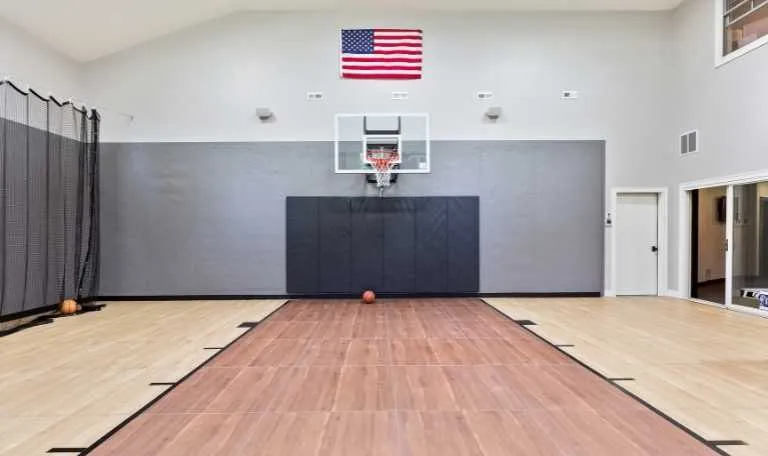
Image Source: sportsvenuecalculator.com
Fathoming the Total Investment: Key Cost Drivers
Several elements contribute to the overall basketball court material costs and labor. Let’s break down the primary areas that will impact your final bill.
Site Preparation and Foundation
Before any basketball magic can happen, the ground needs to be ready. This is a crucial step that affects the longevity and safety of your court.
- Excavation and Grading: If you’re building from scratch, you’ll need to clear the land, remove obstacles, and level the area. This can involve heavy machinery and skilled labor. The depth of excavation and the complexity of the terrain will influence this cost.
- Sub-base Preparation: A stable foundation is key. This usually involves laying down gravel or crushed stone and compacting it. Proper drainage is also essential to prevent water damage.
- Concrete Slab: For most indoor courts, a concrete slab is the standard foundation. The thickness of the slab, the quality of the concrete mix, and any reinforcement (like rebar or wire mesh) will affect the price. A thicker, more reinforced slab will be more expensive but also more durable.
The Playing Surface: Indoors and Out
The indoor basketball court flooring cost is one of the most significant line items. The type of flooring you choose directly impacts the feel of the game, player safety, and your budget.
- Hardwood Flooring: This is the gold standard for professional and high-level recreational play. It offers excellent shock absorption, ball bounce, and a classic aesthetic.
- Types: Maple is the most common choice due to its durability and light color. Other woods like oak can be used but are less typical for basketball courts.
- Installation: Professional installation is almost always recommended for hardwood. This includes the subfloor system (which is crucial for shock absorption), the wood planks themselves, sanding, and finishing.
- Cost: Expect to pay anywhere from \$10 to \$30 per square foot for quality hardwood flooring and installation. For a standard regulation court (94 ft x 50 ft), this alone could be \$47,000 to \$141,000.
- Synthetic/Vinyl Flooring: These are a more budget-friendly alternative to hardwood and are often used in multi-purpose sports facilities or for residential courts.
- Types: Options include vinyl tiles, rolled vinyl, or interlocking rubber tiles. They come in various thicknesses and densities, each offering different levels of cushioning and durability.
- Installation: Generally easier and less expensive to install than hardwood, especially interlocking systems which can even be a DIY project for smaller areas.
- Cost: Vinyl flooring can range from \$3 to \$15 per square foot installed.
- Rubber Flooring: Often found in gyms or training facilities, rubber flooring provides excellent shock absorption and durability. It’s great for reducing impact on joints.
- Cost: Prices can vary from \$4 to \$12 per square foot, depending on thickness and material.
- Painted Concrete: For a very basic and budget-conscious option, painting a concrete slab can create a playable surface. However, it offers minimal shock absorption and can be slippery.
- Cost: The cost here is primarily for high-quality sports paint and line marking, which can be a few hundred to a couple of thousand dollars for a court.
Building the Structure: The Enclosure
For an indoor court, you need a building. This is often the largest expense.
Pre-fabricated Structures (Metal Buildings/Astro-Dome Style)
These offer a quicker construction timeline and can sometimes be more cost-effective than traditional building methods, especially for larger clear-span areas needed for a basketball court.
- Materials: Steel frames, metal sheeting, insulation, and roofing are the primary components.
- Foundation: Still requires a concrete foundation.
- Features: Often come with basic doors and ventilation. Windows, advanced insulation, and specific aesthetic finishes will add to the cost.
- Cost: The cost per square foot can range widely, from \$30 to \$100+, depending on size, height, complexity, and included features. A 10,000 sq ft structure (roughly the size of a regulation court plus surrounding space) could be anywhere from \$300,000 to \$1,000,000 or more.
Traditional Construction (Wood or Masonry)
Building a conventional structure offers more design flexibility but can be more time-consuming and potentially more expensive, especially for large, open spaces.
- Framing: Wood framing or steel framing can be used. Steel is often preferred for larger clear spans required for courts.
- Walls: Plywood, drywall, concrete blocks, or other masonry options.
- Roofing: Trusses, rafters, and various roofing materials like metal, asphalt shingles, or membranes.
- Insulation: Crucial for temperature control and reducing energy costs.
- Doors and Windows: For access, natural light, and ventilation.
- HVAC System: Essential for maintaining a comfortable playing environment.
- Cost: This is highly variable. A basic structure might start at \$100 per square foot, while a climate-controlled, well-finished building could easily exceed \$300 per square foot.
Essential Court Accessories and Fixtures
Beyond the playing surface and the building, you need the actual basketball setup and other amenities.
- Backboards:
- Acrylic/Tempered Glass: Offer the best rebound and are standard for most competitive play. Professional installation and safety features are critical.
- Shatter-resistant Acrylic: A good middle ground.
- Fiberglass/Polycarbonate: More budget-friendly options.
- Cost: \$300 – \$2,000+ per backboard.
- Rims (Hoops):
- Breakaway Rims: Essential for safety, allowing the rim to flex under pressure.
- Fixed Rims: Less expensive but pose a higher injury risk.
- Cost: \$100 – \$500+ per rim.
- Nets: Durable nylon or chain nets.
- Cost: \$20 – \$50 per net.
- Padding: Padding for the poles and surrounding walls is crucial for safety.
- Cost: \$50 – \$200+ for pole pads; wall padding can be significantly more.
- Court Lines: Specialized sports paint is used to mark the boundaries, free-throw lines, three-point arcs, etc.
- Cost: \$300 – \$1,000+ for professional line painting.
- Lighting: Adequate, glare-free lighting is vital for play. LED fixtures are energy-efficient and provide excellent illumination.
- Cost: \$500 – \$5,000+, depending on the number and type of fixtures, and installation.
- Scoreboard: From a simple manual scoreboard to an electronic one.
- Cost: \$200 – \$2,000+.
- Bench Seating: For players and spectators.
- Cost: \$100 – \$500+ per bench.
- Ventilation/Fans: Crucial for air circulation and comfort, especially in larger enclosed spaces.
- Cost: \$300 – \$2,000+.
Labor and Installation Costs
This is a significant part of the residential basketball court cost and the cost to build an indoor gym.
- General Contractors: For overseeing the entire project.
- Specialized Installers: For flooring, structural elements, and court equipment.
- Electricians, Plumbers, HVAC Technicians: If you’re building a full structure with amenities.
- Labor Rates: Vary by region and the complexity of the work. Expect labor to be a substantial portion of the overall budget. A professional basketball court installation cost often includes a significant labor component.
Permitting and Professional Fees
Don’t forget the bureaucratic necessities.
- Building Permits: Required by your local municipality. Costs vary based on the project’s scope and location.
- Architectural/Engineering Fees: If you’re designing a custom building or require structural plans.
- Inspections: During and after construction.
Budgeting for Your Indoor Court: Different Scenarios
Let’s explore some hypothetical cost scenarios to give you a clearer picture. These are estimates, and actual costs will vary.
Scenario 1: The Backyard Hoop House (Small, Recreational)
This is for a smaller, more casual setup, perhaps in a large garage or a custom-built shed-like structure.
- Structure: A pre-engineered metal building or a well-built shed, approximately 30ft x 40ft.
- Cost: \$15,000 – \$30,000
- Foundation: Concrete slab (6-8 inches thick).
- Cost: \$5,000 – \$10,000
- Flooring: High-quality interlocking rubber tiles or durable vinyl sports flooring.
- Cost: \$2,000 – \$6,000 (for 1,200 sq ft)
- Backboard & Hoop: One adjustable in-ground hoop system.
- Cost: \$800 – \$2,500
- Lighting: Basic LED shop lights.
- Cost: \$500 – \$1,500
- Court Lines: DIY or basic professional painting.
- Cost: \$300 – \$700
- Ventilation: Large fans.
- Cost: \$200 – \$500
- Permits & Miscellaneous:
- Cost: \$1,000 – \$3,000
Estimated Total for Scenario 1: \$25,000 – \$55,000
Scenario 2: The Family Fun Court (Medium, Residential)
This focuses on a more robust, dedicated space for family and friends, likely a standalone building.
- Structure: A custom-built or pre-fab metal building, around 60ft x 80ft (allowing for court and some walking space).
- Cost: \$50,000 – \$120,000
- Foundation: Reinforced concrete slab (8-10 inches thick) with proper grading and drainage.
- Cost: \$20,000 – \$40,000
- Flooring: Mid-range synthetic sports flooring (e.g., quality vinyl or specialized rubber system).
- Cost: \$10,000 – \$25,000 (for 4,800 sq ft)
- Backboards & Hoops: Two durable, adjustable in-ground hoop systems.
- Cost: \$2,000 – \$5,000
- Lighting: Professional LED court lighting for even illumination.
- Cost: \$2,000 – \$5,000
- Court Lines: Professional line painting.
- Cost: \$500 – \$1,000
- Padding: Pole pads and basic wall padding.
- Cost: \$1,000 – \$3,000
- Ventilation/Basic HVAC: Fans and possibly a basic climate control system.
- Cost: \$2,000 – \$7,000
- Permits & Professional Fees:
- Cost: \$5,000 – \$15,000
Estimated Total for Scenario 2: \$90,000 – \$220,000
Scenario 3: The Community/Club Court (Large, Commercial/Semi-Commercial)
This is for a higher-quality, potentially full-size court, built to accommodate more rigorous use and possibly larger crowds. This is where commercial basketball court builder cost becomes more relevant.
- Structure: Custom-designed building (traditional construction or a high-quality pre-fab structure), approx. 100ft x 120ft (to accommodate a 94ft x 50ft court plus amenities).
- Cost: \$200,000 – \$600,000+
- Foundation: Heavy-duty, reinforced concrete slab with advanced subfloor systems for superior shock absorption.
- Cost: \$80,000 – \$200,000
- Flooring: Premium hardwood flooring with a professional subfloor system.
- Cost: \$50,000 – \$150,000+ (for 4,700 sq ft court area)
- Backboards & Hoops: Two professional-grade, breakaway glass backboard and rim systems.
- Cost: \$5,000 – \$15,000
- Lighting: High-quality, sports-specific LED lighting designed for minimal glare and optimal visibility.
- Cost: \$10,000 – \$30,000
- Court Lines: Precision line painting with multiple coats.
- Cost: \$1,000 – \$2,500
- Padding: Full wall padding and professional pole padding.
- Cost: \$5,000 – \$15,000
- HVAC System: Robust climate control system for consistent temperature and humidity.
- Cost: \$15,000 – \$40,000
- Scoreboard: Electronic scoreboard.
- Cost: \$1,000 – \$5,000
- Amenities: Benches, potentially basic restrooms, water fountains.
- Cost: \$5,000 – \$20,000+
- Permits, Design & Professional Fees:
- Cost: \$20,000 – \$70,000+
Estimated Total for Scenario 3: \$400,000 – \$1,200,000+
Cost-Saving Strategies for Your Indoor Basketball Court
If the initial figures seem daunting, here are some ways to manage your budget for indoor basketball court expenses:
- Start Smaller: Opt for a smaller court size or a less elaborate structure if space and budget are primary concerns.
- Phased Approach: Build the basic structure and court now, and add advanced features like premium flooring, scoreboards, or extensive padding later as funds allow.
- DIY Where Possible: For smaller projects, you might be able to handle site preparation, painting, or assembling certain components yourself to save on labor. However, for structural work or specialized flooring, professional help is usually essential.
- Choose Flooring Wisely: While hardwood is ideal, high-quality synthetic flooring can offer a great playing experience at a fraction of the cost.
- Pre-fabricated Buildings: For larger structures, explore pre-fabricated metal buildings or kits. These can sometimes be more cost-effective than traditional stick-built construction, especially if you use a reputable commercial basketball court builder.
- Shop Around: Get multiple quotes from different contractors, material suppliers, and flooring installers. Compare pricing for similar quality products and services.
- Refurbish Existing Spaces: If you have a large garage, barn, or warehouse space, you might be able to convert it into an indoor court, saving significantly on the cost of building a new structure. This would primarily involve flooring, lighting, and equipment installation.
Frequently Asked Questions (FAQ)
Q1: What is the biggest cost factor when building an indoor basketball court?
A1: The biggest cost factor is almost always the building structure itself, followed closely by the playing surface (especially if opting for hardwood).
Q2: Can I build a regulation-size indoor basketball court on a budget?
A2: A regulation-size court (94ft x 50ft) is challenging to build on a very tight budget due to the significant space and structural requirements. However, smaller, recreational-sized courts are more achievable for modest budgets.
Q3: How much does indoor basketball court flooring cost per square foot?
A3: The cost for indoor basketball court flooring varies greatly. Synthetic flooring can range from \$3 to \$15 per square foot, while premium hardwood can cost \$10 to \$30+ per square foot, including installation.
Q4: What are the typical home basketball court expenses?
A4: Home basketball court expenses include the building structure, foundation, flooring, hoop system, lighting, and accessories. Costs can range from under \$30,000 for a basic setup to well over \$200,000 for a more substantial residential court.
Q5: Who is a good commercial basketball court builder?
A5: Finding a good builder involves research. Look for companies with extensive experience in sports facility construction, check reviews and testimonials, and ask for references. Companies specializing in indoor sports courts will have the most relevant expertise.
Q6: What is the cost to build an indoor gym that includes a basketball court?
A6: The cost to build an indoor gym with a basketball court will be significantly higher than just a court alone, as it would include extensive fitness equipment, specialized flooring for various areas, and potentially more complex HVAC and design elements. It could easily add tens or hundreds of thousands of dollars to the project cost.
Q7: What are basketball court material costs besides flooring?
A7: Besides flooring, basketball court material costs include the backboard, rim, net, pole padding, wall padding, court line paint, and lighting fixtures.
Q8: What is professional basketball court installation cost?
A8: Professional basketball court installation cost encompasses labor for site preparation, foundation work, flooring installation (especially hardwood), and the mounting of court equipment. This can represent 30-50% of the total project cost.
Building an indoor basketball court is a significant investment, but with careful planning and a realistic understanding of the costs involved, your dream can become a reality. Whether you’re aiming for a professional setup or a backyard haven, this guide provides the framework to help you budget effectively and make informed decisions.