You can train for basketball by focusing on fundamental skills, consistent practice, and holistic physical conditioning. This includes developing shooting accuracy, mastering dribbling skills, honing defensive techniques, improving overall conditioning for basketball, and incorporating agility training and strength training for basketball. A comprehensive approach to basketball strength and conditioning will elevate your basketball performance.
Basketball is a sport of incredible athleticism, strategic thinking, and, most importantly, skill. Whether you’re aiming to make your school team, dominate your local league, or even dream of playing professionally, dedicated training is the bedrock of success. This comprehensive guide will break down how to train for basketball, covering everything from essential skills and effective drills to the physical conditioning that separates good players from great ones. We’ll delve into specific basketball drills, shooting practice techniques, dribbling skills development, defensive techniques, and the crucial elements of conditioning for basketball, agility training, and strength training for basketball. By the end, you’ll have a clear roadmap to enhance your basketball performance.
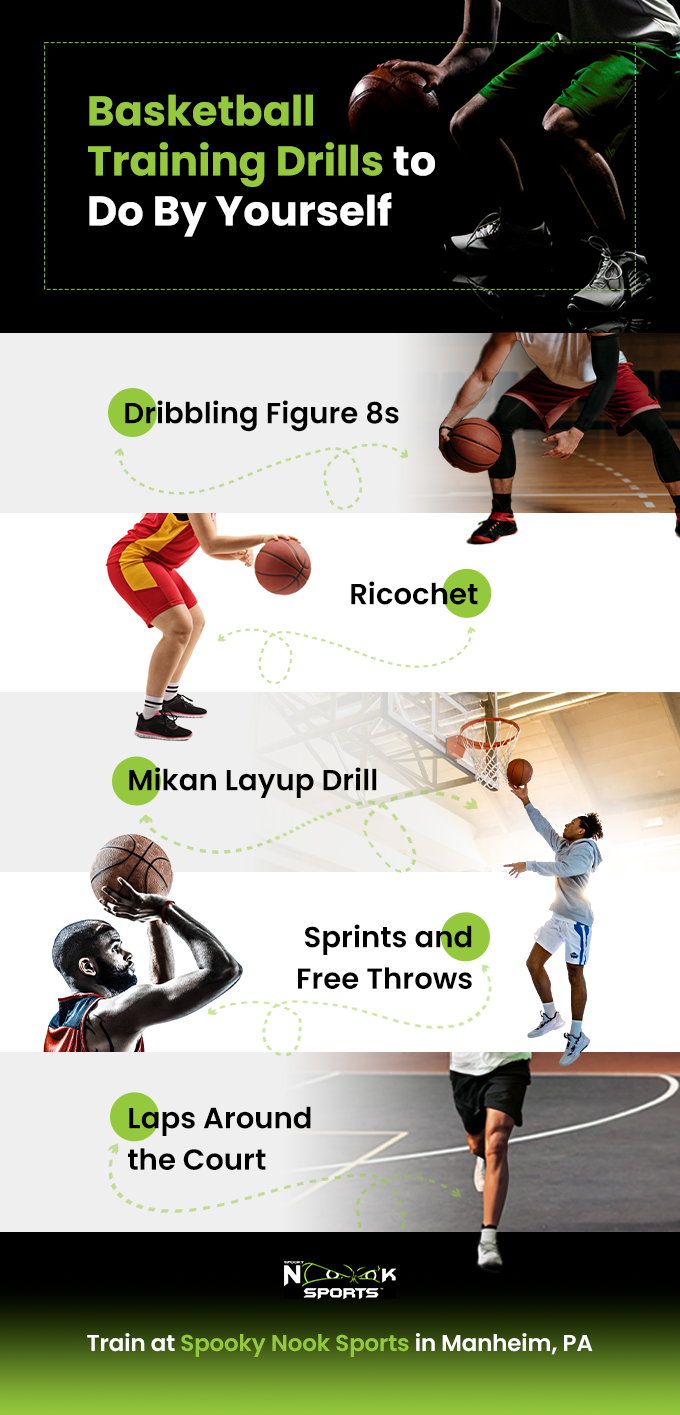
Image Source: www.spookynooksports.com
Mastering the Fundamentals: Building a Solid Foundation
Every great basketball player starts with the basics. Before you can execute fancy crossovers or game-winning shots, you need to build a strong foundation in the core skills. These are the building blocks upon which all advanced techniques are built.
Shooting Practice: The Art of the Swish
Shooting is arguably the most recognized skill in basketball. Consistent and accurate shooting can change the outcome of any game.
Form Shooting
This is the absolute starting point for any aspiring shooter. It’s about repetition and muscle memory.
- Balance: Stand with your feet shoulder-width apart, knees slightly bent.
- Grip: Hold the ball with your fingertips, not your palm. Your shooting hand should be behind the ball, and your non-shooting hand on the side for support.
- Elbow Alignment: Keep your shooting elbow tucked in, forming an “L” shape.
- Eyes on the Target: Focus on the rim or a specific spot on the backboard.
- Follow-Through: Extend your shooting arm upwards, flicking your wrist as you release the ball. Hold this follow-through until the ball reaches the basket.
Progression of Shooting Drills
Once form shooting is ingrained, you can move to more dynamic drills.
- Mikan Drill: A classic for developing touch around the basket and shooting with both hands. Stand under the basket and alternate layups with your right and left hands, rebounding your own shot. Aim for 10 makes with each hand.
- Form Shooting from Close Range: Start just a few feet from the basket, focusing purely on form. Gradually move back as you make a set number of shots (e.g., 10 makes).
- Mid-Range Shooting: Once comfortable, expand to mid-range spots. Work on shooting off the catch and shooting off the dribble.
- Three-Point Shooting: For players who can shoot consistently from mid-range, the three-point line is the next frontier. Focus on maintaining good form even from this distance.
Table 1: Shooting Practice Progression
| Stage | Focus | Drills | Repetition Goal (per drill) |
|---|---|---|---|
| Foundation | Perfecting Form | Form Shooting Close Range, Mikan Drill | 10-20 makes |
| Mid-Range | Accuracy & Consistency | Catch & Shoot (various spots), Pull-up Jumpshots | 20-30 makes per spot |
| Long-Range | Three-Point Accuracy | Catch & Shoot 3-pointers, Step-back 3-pointers | 15-25 makes per spot |
| Game Simulation | Shooting Under Pressure | Shooting off screens, Shooting after dribble | 5-10 makes each |
Dribbling Skills: The Foundation of Ball Control
Dribbling is how you move the ball on the court, evade defenders, and create scoring opportunities. Strong dribbling skills are essential for every player, but particularly for basketball drills for guards.
Developing Elite Dribbling
- Ball Security: Keep the ball low and protected, away from defenders. Use your non-dribbling hand as a shield.
- Head Up: The most crucial aspect of dribbling is keeping your head up to see the court, your teammates, and the defense.
- Strong Dribble: Dribble the ball with force, not a soft touch. This allows for quicker changes of direction and better control.
- Finger Control: Use your fingertips, not your palm, to control the ball. This provides better feel and manipulation.
Essential Dribbling Drills
- Stationary Dribbling: Practice different dribble types (low, high, crossover, between the legs, behind the back) while standing still. Focus on speed, control, and changing hands.
- Cone Drills: Set up cones and dribble through them, executing various moves at each cone. This simulates navigating through traffic.
- Crossover Drill: Dribble to a cone, cross over, and continue.
- Between the Legs: Dribble to a cone, go between your legs, and proceed.
- Behind the Back: Dribble to a cone, go behind your back, and move on.
- Full Court Dribbling: Dribble up and down the court, changing pace and direction, and using different dribble moves.
- Two-Ball Dribbling: This advanced drill significantly enhances hand-eye coordination and ambidextrous dribbling. Dribble two balls simultaneously, alternating pound dribbles, two-ball crossovers, and two-ball between-the-legs dribbles.
Table 2: Dribbling Drills for Improvement
| Drill Name | Objective | Key Focus |
|---|---|---|
| Stationary Dribbling | Ball control, hand speed, ambidexterity | Low dribble, high dribble, pound dribbles |
| Cone Dribbling | Agility, change of direction, move execution | Crossovers, between legs, behind the back moves |
| Full Court Dribbling | Pace control, vision, transition dribbling | Change of pace, head up, avoiding defenders |
| Two-Ball Dribbling | Hand-eye coordination, ambidexterity, rhythm | Simultaneous dribbles, alternating dribbles |
Defensive Techniques: The Unsung Hero of Basketball
Offense might win games, but defense wins championships. Strong defensive techniques are crucial for stopping opponents, creating turnovers, and controlling the tempo.
Principles of Sound Defense
- Stance: Maintain a low, athletic stance with your feet shoulder-width apart, knees bent, and back straight. Your weight should be on the balls of your feet.
- Vision: Keep your head up and eyes on your opponent’s hips or the ball.
- Footwork: Use choppy, quick steps (like defensive slides) to stay in front of your man. Avoid crossing your feet.
- Active Hands: Use your hands to disrupt dribbles, deflect passes, and contest shots without fouling.
- Communication: Talk to your teammates, call out screens, and alert them to open players.
Key Defensive Drills
- Defensive Slides: Practice sliding laterally across the court, maintaining your defensive stance. This builds leg strength and endurance for defensive footwork.
- Close-Out Drills: Simulate closing out on a shooter. Start in a help position, sprint to your man as they receive the ball, and stop with a balanced stance, hands up to contest the shot.
- Mirror Drills: One player dribbles, and the other player (the defender) mirrors their movements, staying in front of them without touching the ball. This is excellent for basketball drills for guards.
- Screen Defense: Practice navigating through or going over screens. This requires good footwork and communication with a teammate.
- Rebounding Drills: Boxing out is a fundamental defensive technique. Practice anticipating the shot and aggressively sealing off your opponent to secure the rebound.
Table 3: Defensive Technique Drills
| Drill Name | Objective | Key Focus |
|---|---|---|
| Defensive Slides | Lateral quickness, agility, endurance | Low stance, choppy steps, staying in front |
| Close-Outs | Quick reaction, controlled closing space | Sprint, chop steps, contest shot, recover |
| Mirror Defense | Agility, anticipation, staying in front | Mirroring dribble moves, maintaining stance |
| Screen Navigation | Dealing with on-ball and off-ball screens | Going over, going under, communication |
| Box-Out Drills | Rebounding, defensive positioning | Sealing opponent, active hands, securing ball |
Conditioning for Basketball: The Engine of Performance
Basketball is a demanding sport that requires a high level of physical conditioning. Players need to be able to sprint, jump, cut, and change direction repeatedly for an entire game. Effective conditioning for basketball is paramount.
Aerobic and Anaerobic Fitness
Basketball requires both sustained energy (aerobic) and bursts of explosive power (anaerobic).
- Aerobic Fitness: This allows you to maintain energy levels throughout the game without getting easily winded.
- Anaerobic Fitness: This is crucial for sprinting, explosive jumping, and quick changes of direction.
Conditioning Drills
- Suicides/Line Drills: Sprinting to various lines on the court and back. This is a classic for building basketball-specific endurance.
- Shuttle Runs: Similar to suicides but often with more directional changes.
- Interval Training: Alternating periods of high-intensity work with short recovery periods. This mimics the stop-and-start nature of basketball.
- Long-Distance Running: While not as specific as interval training, it builds a solid aerobic base.
Agility Training: Quickness and Change of Direction
Agility is the ability to change your body’s position efficiently and quickly. This is vital for defense, offense, and avoiding defenders. Agility training is a core component of basketball strength and conditioning.
Agility Drills
- Ladder Drills: Using an agility ladder to perform various footwork patterns (e.g., single leg hops, in-out drills, shuffle steps). These improve foot speed and coordination.
- Cone Drills (Agility Focused): Setting up cones in different patterns (e.g., T-test, Pro Agility drill) to work on quick changes of direction.
- Reaction Drills: Drills where you have to react to a visual or auditory cue, such as a coach pointing or clapping.
Table 4: Agility Drills for Basketball
| Drill Name | Objective | Key Focus |
|---|---|---|
| Agility Ladder Drills | Foot speed, coordination, quickness | In-out, Icky shuffle, quick feet |
| T-Test | Forward, lateral, and backward movement | Change of direction, acceleration, deceleration |
| Pro Agility (5-10-5) | Lateral quickness, change of direction | Quick feet, efficient turns, proper mechanics |
| Reaction Drills | Responsiveness, visual/auditory processing | Moving to a stimulus, quick decision-making |
Strength Training for Basketball: Power and Durability
Strength training for basketball is not about becoming a bodybuilder; it’s about building functional strength that translates to the court. This includes building power, improving explosiveness, and reducing the risk of injury. This is a critical part of basketball strength and conditioning.
Key Muscle Groups to Target
- Lower Body: Quads, hamstrings, glutes, calves. These are essential for jumping, sprinting, and defensive movements.
- Core: Abs, obliques, lower back. A strong core provides stability and power transfer.
- Upper Body: Back, chest, shoulders, arms. Important for shooting, passing, rebounding, and finishing through contact.
Effective Strength Training Exercises
- Lower Body:
- Squats: Back squats, front squats, goblet squats.
- Deadlifts: Conventional, Romanian deadlifts.
- Lunges: Forward, reverse, lateral lunges.
- Calf Raises: For explosive ankle power.
- Core:
- Plank Variations: Standard plank, side planks.
- Russian Twists: With or without weight.
- Leg Raises: For lower abdominal strength.
- Upper Body:
- Push-ups: Various variations.
- Bench Press: For chest and shoulder strength.
- Pull-ups/Chin-ups: For back and bicep strength.
- Overhead Press: For shoulder strength.
Plyometrics for Explosiveness
Plyometric exercises involve quick, explosive movements that stretch and contract muscles rapidly. These are crucial for increasing vertical leap and improving acceleration.
- Box Jumps: Jumping onto a raised platform.
- Jump Squats: Squatting down and exploding upwards into a jump.
- Depth Jumps: Stepping off a box and immediately jumping as high as possible upon landing.
- Bounding: Exaggerated running strides that emphasize hang time and distance.
Table 5: Strength and Plyometric Exercises for Basketball
| Muscle Group | Strength Exercises | Plyometric Exercises |
|---|---|---|
| Lower Body | Squats, Deadlifts, Lunges | Box Jumps, Jump Squats, Bounding |
| Core | Planks, Russian Twists | Medicine Ball Slams |
| Upper Body | Push-ups, Bench Press, Pull-ups | Plyo Push-ups, Medicine Ball Throws |
Integrating Skills and Conditioning for Peak Basketball Performance
The goal is to weave all these elements together to create a well-rounded basketball player. Your training should reflect game-like situations.
Skill-Specific Conditioning
- Shooting Drills with Fatigue: Practice shooting after a sprint or a set of defensive slides to simulate game conditions.
- Dribbling Drills under Pressure: Have a defender apply light pressure while you perform dribbling drills.
Putting It All Together: Sample Training Week
A sample training week could look like this, assuming you have access to a court and gym facilities:
Monday:
* Morning: Strength Training (Lower Body Focus) + Light Cardio (e.g., jogging)
* Afternoon: Shooting Practice (Form, Mid-Range, 3-Pointers) + Dribbling Drills (Stationary and Cone Drills)
Tuesday:
* Morning: Agility Training (Ladder Drills, Cone Agility) + Plyometrics
* Afternoon: Defensive Drills (Slides, Close-Outs, Mirror Drills) + Conditioning (Suicides)
Wednesday:
* Active Recovery: Light shooting, stretching, foam rolling, or a very light jog. Focus on rest and recovery.
Thursday:
* Morning: Strength Training (Upper Body & Core Focus)
* Afternoon: Skill Integration Drills (e.g., dribble-drive and finish, shooting off the dribble after a defensive slide) + Game-like Situations (1-on-1, 3-on-3)
Friday:
* Morning: High-Intensity Interval Training (sprint intervals on court)
* Afternoon: Shooting Practice (Focus on weak spots) + Conditioning Drills (Shuttle Runs)
Saturday:
* Game Day Simulation: Full court scrimmages or practice games, focusing on applying all skills and conditioning learned during the week.
Sunday:
* Rest: Complete rest or very light active recovery if needed.
Important Considerations:
- Listen to Your Body: Rest and recovery are as important as training. Don’t push through serious pain.
- Nutrition and Hydration: Fuel your body properly for performance and recovery.
- Sleep: Aim for 7-9 hours of quality sleep per night.
- Warm-up and Cool-down: Always perform a dynamic warm-up before training and a static cool-down afterward.
Advanced Training for Pro Performance
To reach elite levels of basketball performance, players must continuously push their boundaries. This involves refining existing skills, developing new ones, and optimizing their physical and mental capabilities.
Advanced Shooting Techniques
- Shooting off the Dribble: Mastering pull-up jumpers, step-back jumpers, and floaters.
- Shooting off Screens: Learning to read screens, create separation, and shoot efficiently from various angles.
- Free Throw Routine: Developing a consistent pre-shot routine for mental focus.
Advanced Dribbling Moves
- Hesitation Dribble: A change-of-pace move to freeze defenders.
- In-and-Out Dribble: A deceptive move to get past a defender.
- Eurostep: A series of steps and changes of direction to avoid contact at the rim.
- Combo Moves: Combining multiple dribble moves for unpredictable attacks.
Advanced Defensive Strategies
- Anticipation: Reading passing lanes and anticipating opponent movements.
- Help Defense: Effectively rotating and helping teammates.
- Full-Court Pressure: Applying defensive pressure across the entire court.
- Defending Pick-and-Rolls: Understanding different defensive coverages for this common play.
Specialized Conditioning
- Sport-Specific Strength: Incorporating exercises that mimic basketball movements, like medicine ball throws for rotational power.
- Endurance for Overtime: Building the stamina to perform at a high level even in extended games.
- Injury Prevention: Focusing on mobility, flexibility, and strengthening stabilizer muscles.
Frequently Asked Questions (FAQ)
How often should I practice basketball?
For optimal improvement, aim to practice basketball at least 3-5 times per week. Consistency is key, and dedicating focused time to drills and conditioning will yield the best results.
What is the most important skill in basketball?
While shooting is often highlighted, ball handling and the ability to keep your head up while dribbling are arguably more foundational. Without good ball-handling, other offensive skills are difficult to execute.
How can I improve my vertical jump?
Improving your vertical jump requires a combination of strength training (squats, deadlifts), plyometrics (box jumps, depth jumps), and proper technique. Consistent training focusing on explosiveness is crucial.
Should I focus more on offense or defense?
A well-rounded player excels on both ends of the court. While it’s natural to have strengths, dedicating time to improving weaker areas, especially defense, will make you a more valuable player.
How long does it take to see improvements in basketball training?
Significant improvements typically start to become noticeable within 4-6 weeks of consistent, focused training. However, becoming a truly skilled player is a long-term commitment, often taking years of dedicated practice.
What are basketball drills for guards specifically?
Basketball drills for guards heavily emphasize dribbling skills, court vision, shooting off the dribble, and defensive quickness. Examples include cone dribbling drills with various moves, full-court transition drills, and defensive slide drills.
By following this comprehensive guide, focusing on consistent practice of fundamental skills, and dedicating yourself to rigorous conditioning, you can significantly elevate your basketball performance and achieve your goals on the court. Remember, dedication, hard work, and smart training are the cornerstones of becoming a great basketball player.