Wondering about the price of a half court basketball setup? The cost can range from a few hundred dollars for a basic DIY setup to upwards of $10,000 or more for a professionally installed, premium backyard basketball court. This price depends on many factors, including the materials used, the size, and the complexity of the installation.
Building a half court basketball court is a fantastic way to bring the joy of the game right to your home. Whether you dream of shooting hoops in your driveway, backyard, or even a dedicated sports area, knowing the potential costs involved is crucial for planning. This guide will walk you through everything you need to know to estimate the half court construction cost, from the ground up.
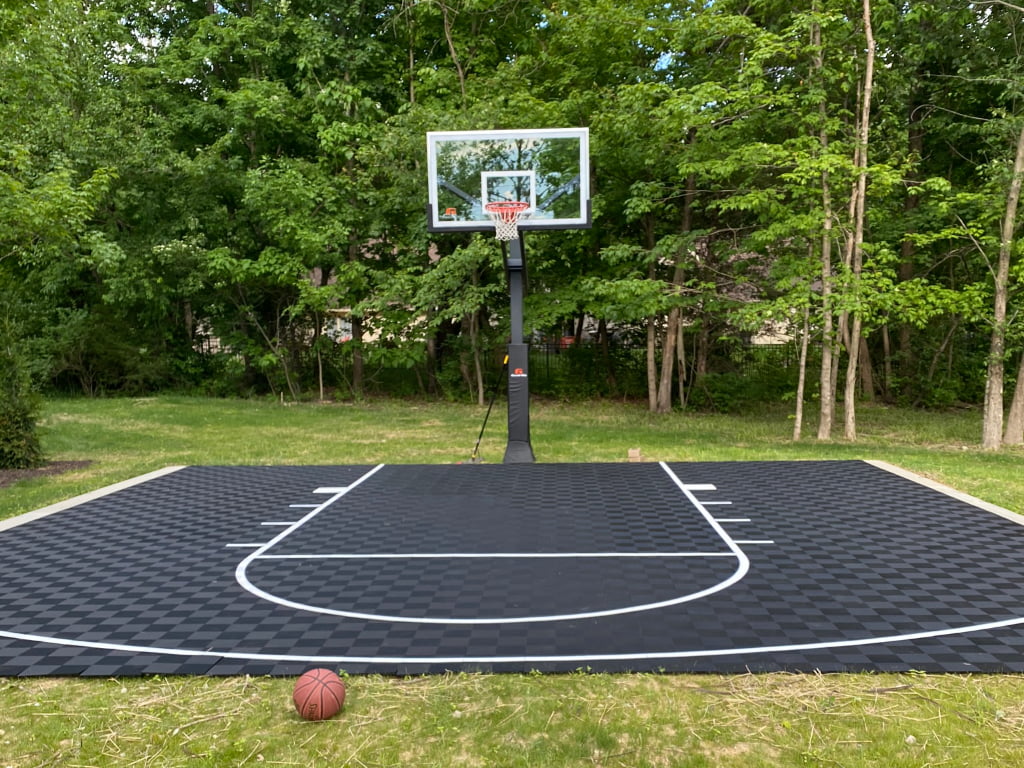
Image Source: modutile.com
Deciphering the Core Components of Cost
Several key elements contribute to the overall expense of your half court. Let’s break them down:
The Foundation: What’s Underneath?
The surface of your court is arguably the most significant cost factor. You have a few primary options, each with its own pros, cons, and price points.
Basketball Court Surfacing Cost
- Concrete: This is a popular and durable choice. It offers a firm, consistent bounce and is built to last.
- Asphalt Half Court Price: Asphalt is another robust option, often chosen for its resilience and slightly lower cost than concrete. It’s known for good drainage and can withstand various weather conditions.
- Concrete Half Court Cost: Expect concrete to be on the higher end for surfacing. The concrete half court cost typically includes excavation, grading, reinforcement (rebar or mesh), pouring, finishing, and sealing.
- Acrylic/Sports Coatings: These are applied over a concrete or asphalt base. They provide color, grip, and cushioning.
- Modular Tiles: Interlocking plastic tiles offer a quick installation and a more forgiving surface. They can be more expensive upfront but are excellent for DIY projects and can be easily replaced if damaged.
Hoop Installation Cost
This is another major piece of the puzzle. The type of basketball hoop you choose will significantly impact the total price.
- In-Ground Systems: These are the most common and provide the most stable playing experience. They are permanently anchored into the ground, usually with concrete.
- Anchor-Bolt Systems: These require a concrete footing and bolts to secure the pole.
- Direct-Burial Systems: The pole is directly buried in concrete.
- Wall-Mounted Systems: These attach to an existing structure, like a garage or a dedicated pole, saving on direct ground installation costs but requiring a suitable wall.
- Portable Hoops: While not ideal for a permanent half court, these are the cheapest option and offer flexibility. However, they generally don’t provide the same playing experience as a fixed system.
Materials for Half Court
Beyond the surfacing and the hoop, other materials for half court play a role:
- Sub-base Materials: Gravel and sand are often used to create a stable foundation beneath the concrete or asphalt. Proper drainage is key, so a well-compacted sub-base is essential.
- Line Painting: Durable, weather-resistant paint is needed to mark the court lines (including the half-court line, free-throw line, and potentially a three-point arc).
- Edging/Border: To keep materials contained and provide a clean finish, edging materials like concrete curbing or specialized plastic borders might be used.
Pricing Breakdown: From DIY to Professional Installation
Now let’s dive into the actual costs associated with different approaches.
The DIY Half Court Price: Can You Do It Yourself?
For the budget-conscious or the hands-on enthusiast, a DIY half court price can be significantly lower than hiring professionals. However, it requires a considerable investment of time, effort, and potentially specialized tools.
DIY Steps and Associated Costs:
- Site Preparation:
- Excavation: Renting an excavator or hiring a mini-excavator for a day. (Estimate: $100-$300 per day, plus fuel).
- Grading: Ensuring a level surface is critical. If you’re doing it yourself, this can be labor-intensive.
- Sub-base Installation:
- Gravel and Sand: Purchasing and spreading these materials. (Estimate: $500 – $1,500 depending on area size and depth).
- Compaction: Renting a plate compactor. (Estimate: $50-$100 per day).
- Surface Installation:
- Concrete: This is where DIY costs can escalate. Concrete itself is priced per cubic yard. For a standard half court (approx. 30 ft x 30 ft, 4 inches thick), you’d need roughly 11 cubic yards.
- Concrete Material Cost: $100-$150 per cubic yard = $1,100 – $1,650.
- Rebar/Wire Mesh: $100-$200.
- Formwork Lumber: $100-$200.
- Concrete Finishing Tools (Trowels, Floats, Edgers): If you don’t own them, this can add a few hundred dollars.
- Professional Concrete Pour: Hiring a crew to pour and finish can cost an additional $1,500 – $3,000, which negates some of the DIY savings.
- Asphalt: Often purchased in smaller quantities for DIY or delivered in large loads.
- Asphalt Material Cost: Roughly $75-$125 per ton. A half court might require 5-10 tons. (Estimate: $400 – $1,250).
- Asphalt Paving Equipment: Renting a paver and roller can be expensive.
- Modular Tiles:
- Material Cost: $3 – $8 per square foot. For a 900 sq ft half court, this could be $2,700 – $7,200.
- Concrete: This is where DIY costs can escalate. Concrete itself is priced per cubic yard. For a standard half court (approx. 30 ft x 30 ft, 4 inches thick), you’d need roughly 11 cubic yards.
- Hoop Purchase and Installation:
- Mid-Range In-Ground Hoop: $400 – $1,000.
- DIY Concrete Mixing for Anchor: If not using a pre-made anchor kit, you’ll need concrete mix. (Estimate: $50-$100).
- Drilling/Digging: Post-hole digger rental or manual labor.
- Line Painting:
- Paint and Brushes/Rollers: $50 – $100.
- Stencils: For precise lines, especially arcs. $20-$50.
Estimated DIY Total: For a basic concrete or asphalt half court with a mid-range hoop, a DIY approach might range from $2,000 to $5,000. Modular tiles could push this higher.
Professional Installation: The Backyard Basketball Court Installation Cost
When you hire professionals, you’re paying for expertise, specialized equipment, and often, faster completion times. This is where the backyard basketball court installation cost can climb.
Professional Services and Their Impact:
- Site Assessment and Design: Professionals will assess your site for drainage, slope, and suitability. They can help with the design of your half court.
- Excavation and Grading: These services are typically included in the overall quote and done with heavy machinery for precision.
- Sub-base Preparation: Proper compaction and layering are critical for longevity, and professionals ensure this is done correctly.
- Surface Installation:
- Concrete: Professionally poured and finished concrete for a half court can cost $4,000 – $8,000. This includes all materials, labor, and finishing.
- Asphalt: An asphalt half court price from a contractor typically falls between $3,000 – $6,000.
- Acrylic Coating: Applying acrylics over a new or existing concrete/asphalt surface adds $1,000 – $3,000 for multiple layers and colors.
- Hoop Installation:
- Professional In-Ground Hoop Installation: Many contractors include this in their court packages or charge separately.
- Hoop Cost: $500 – $2,500+ (for higher-end, adjustable systems).
- Installation Labor: $200 – $500.
- Professional In-Ground Hoop Installation: Many contractors include this in their court packages or charge separately.
- Line Painting: Professionals use specialized equipment for crisp, accurate lines, often with premium durable paints. (Estimate: $100 – $300).
- Permits: Depending on your local municipality, you might need permits for significant construction. Factor in $50 – $200.
Estimated Professional Total: For a professionally installed half court, expect costs to be in the range of $4,000 to $10,000+.
Full Size vs. Half Court Cost: What’s the Difference?
A common question is: full size vs. half court cost. It’s straightforward – a full-sized court is approximately twice the size of a half court.
Size Matters:
- Full Court Dimensions: NBA regulation is 94 feet long by 50 feet wide. FIBA regulation is 91.9 feet long by 49.2 feet wide.
- Half Court Dimensions: Generally, a half court is considered to be the area from the half-court line to the baseline, including the free-throw lane. This is often around 42-47 feet in length and 25-30 feet in width for a standard half-court setup. For a backyard, it might be as simple as marking a 30×30 foot area.
Cost Implications:
- Materials: You’ll need roughly double the amount of surfacing material (concrete, asphalt), sub-base materials, and potentially more paint for lines.
- Labor: Doubling the size often means more than double the labor time for preparation, pouring, finishing, and line painting.
- Hoops: While you only need one hoop for a half court, a full court might necessitate two hoops for more engaging play, doubling that expense.
The Cost Difference: A full-size basketball court installation can easily cost $20,000 to $50,000+, making a half court a much more accessible option for most homeowners. The cost savings for a half court are substantial, often making it the most practical choice for residential use.
Factors Influencing Your Final Price Tag
Several variables can nudge your average half court price up or down:
Material Choices Revisited:
- Concrete vs. Asphalt: Concrete is typically more expensive upfront but can last longer with proper care. Asphalt is generally cheaper but may require resealing sooner.
- Acrylic Coatings: Adding color, lines, and cushioning with acrylics increases the cost but enhances the playing experience and aesthetics.
- Modular Tiles: While offering a softer feel and easier installation, their per-square-foot cost can be higher than basic concrete or asphalt.
Hoop System Selection:
- Adjustable vs. Fixed: Adjustable hoops offer more versatility for different player heights and are usually more expensive.
- Backboard Material: Acrylic, polycarbonate, and tempered glass backboards vary in price and durability. Glass offers the best bounce but is also the most expensive and fragile.
- Rim Quality: Basic breakaway rims are cheaper than professional-grade ones.
Site Conditions:
- Existing Surface: If you have a flat, clear area, preparation costs will be lower. If you need significant excavation, grading, or removal of trees/stumps, expect higher prep costs.
- Drainage: Poor drainage requires additional work to ensure the court doesn’t pool water, which can involve French drains or higher sub-base construction.
- Accessibility: If your property is difficult to access with heavy machinery, labor and delivery costs might increase.
Additional Features:
- Lighting: Adding court lighting for nighttime play will add to the cost.
- Fencing: Enclosing the court for safety or containment.
- Landscaping: Integrating the court into your existing landscape.
- Padding/Safety Features: For younger players, some might opt for padding around posts.
Sample Cost Scenarios
To give you a clearer picture, here are a few hypothetical scenarios:
Scenario 1: Budget-Friendly DIY Concrete Half Court
- Surface: 30×30 ft concrete pad (4 inches thick).
- Hoop: Mid-range in-ground adjustable hoop.
- Installation: Mostly DIY, hiring a concrete pour crew for the main pour and finishing.
- Estimated Cost: $3,000 – $5,500
Scenario 2: Mid-Range Professional Asphalt Half Court
- Surface: 30×30 ft asphalt pad.
- Hoop: Good quality in-ground adjustable hoop.
- Installation: Professional contractor for site prep, asphalt laying, and hoop installation.
- Line Painting: Professional application.
- Estimated Cost: $4,000 – $7,000
Scenario 3: Premium Professional Concrete Half Court with Acrylics
- Surface: 35×35 ft concrete pad (4 inches thick), professionally poured and finished.
- Surface Treatment: Acrylic coating with vibrant colors and sport lines.
- Hoop: High-end in-ground adjustable hoop with a tempered glass backboard.
- Installation: Full professional service including site prep, concrete work, acrylic application, and hoop setup.
- Estimated Cost: $7,000 – $12,000+
Scenario 4: Modular Tile Half Court (DIY)
- Surface: 30×30 ft modular sports tiles.
- Hoop: Mid-range in-ground adjustable hoop.
- Installation: DIY installation of tiles and hoop.
- Estimated Cost: $4,000 – $7,000 (depending on tile quality)
Frequently Asked Questions About Half Court Costs
Q1: Is a half court more affordable than a full court?
Yes, a half court is significantly more affordable than a full court due to the reduced material, labor, and land requirements.
Q2: What is the cheapest way to build a half court?
The cheapest way is typically a DIY approach using basic asphalt or a smaller, simpler concrete pad, combined with a portable or basic in-ground hoop. However, “cheap” can sometimes mean less durability.
Q3: Can I install a basketball hoop on my existing driveway?
You can, but it’s often not recommended for permanent, high-quality play. Driveway concrete might not be thick or reinforced enough, and you’d need to properly anchor the hoop. It’s usually better to have a dedicated court area.
Q4: How long does a concrete half court last?
With proper installation and maintenance, a concrete half court can last 20-30 years or even longer.
Q5: What is the average half court price for professional installation?
The average half court price for professional installation typically falls between $4,000 and $10,000, depending on the chosen materials and features.
Conclusion: Investing in Your Home Court
The cost of a half court basketball setup is a significant investment, but one that can provide years of enjoyment, exercise, and family fun. By carefully considering the different components, materials, and installation methods, you can determine the best approach to fit your budget and your vision for the perfect home court. Whether you opt for a hands-on DIY project or a professionally managed installation, a half court is a valuable addition to any property. Remember to get multiple quotes from contractors if you decide to go the professional route, and thoroughly research DIY methods if you’re tackling it yourself. Happy hooping!