A typical half basketball court, often used for high school or professional games, measures about 2,350 square feet. This figure comes from a full court that is 94 feet long and 50 feet wide. So, half a court means it is 47 feet long and 50 feet wide. This size is good for many players and types of play. It allows for practice or games like 3-on-3.
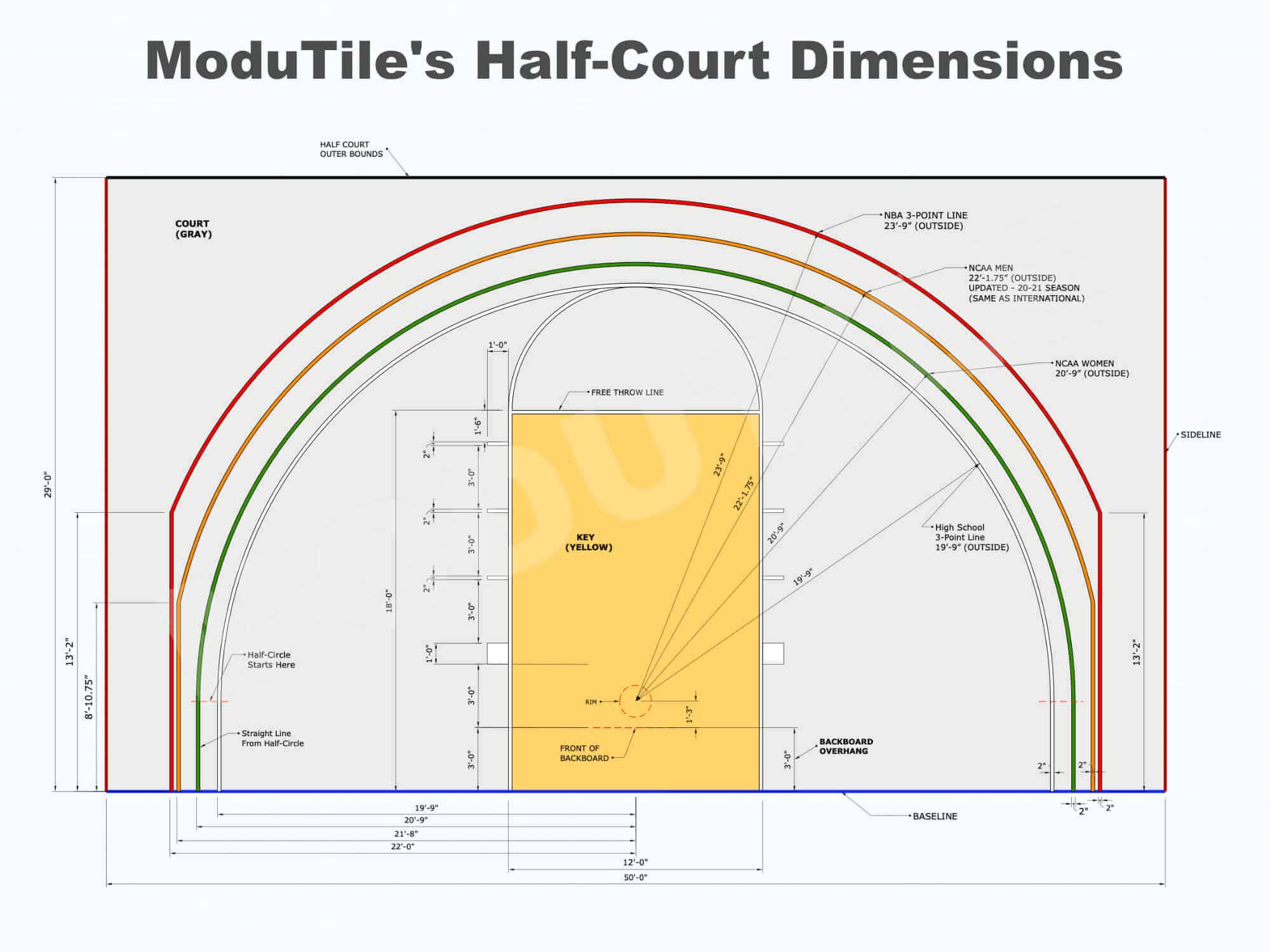
Image Source: modutile.com
Grasping Half Court Dimensions
Many people want to know the size of a half basketball court. It is a common question, especially for those planning to build one. A half court uses less space than a full court. Yet, it still offers plenty of room for good basketball play. Knowing the exact basketball court dimensions helps you plan. It also helps you see what is possible for your space.
A full basketball court has set measurements. These measurements guide how big a half court should be. A standard court is 94 feet long and 50 feet wide. This is for pro and college games. High school courts are a little smaller, usually 84 feet long. Youth courts are even smaller, sometimes 74 feet long. When we talk about a half court, we mean half of the length. The width usually stays the same.
A half court lets players work on many skills. You can shoot, dribble, and play defense. It is perfect for one-on-one games. It also works well for two-on-two or three-on-three matches. These smaller games are often called “half-court” games. They are popular because you need less space and fewer players.
Standard Half Court Measurements Explained
The most common half court measurements come from official full court sizes. To get the square footage, you multiply length by width. For a half court, we take half of the full court’s length. The width stays the same.
Let’s look at a standard full court size first. A standard court size for the NBA or college is 94 feet long. It is 50 feet wide.
To find the area of this full court:
94 feet (length) x 50 feet (width) = 4,700 square feet.
Now, for a half court, we split the length in half.
So, 94 feet / 2 = 47 feet.
The width stays at 50 feet.
To find the area of a standard half court:
47 feet (length) x 50 feet (width) = 2,350 square feet.
This 2,350 square feet is the common answer for a “standard” half court. It gives players enough room for shooting, passing, and moving. It is a good size for serious practice or casual games.
Here is a table showing these measurements:
| Court Type | Full Court Length (feet) | Full Court Width (feet) | Full Court Area (sq ft) | Half Court Length (feet) | Half Court Width (feet) | Half Court Area (sq ft) |
|---|---|---|---|---|---|---|
| NBA / College | 94 | 50 | 4,700 | 47 | 50 | 2,350 |
| High School | 84 | 50 | 4,200 | 42 | 50 | 2,100 |
| Junior High / Youth | 74 | 42 | 3,108 | 37 | 42 | 1,554 |
As you can see, the size changes based on the full court it comes from. Most people think of the NBA or college size when they say “standard.”
Different Half Court Sizes
Not all half courts are the same size. Their dimensions depend on the age group or league they are for. They also depend on the space available.
NBA Half Court Dimensions
When we talk about NBA half court dimensions, we usually mean half of a full NBA court. An NBA court is 94 feet long and 50 feet wide. So, half of that length is 47 feet. The width stays 50 feet.
This means an NBA half court would be 47 feet by 50 feet. Its area is 2,350 square feet. This size allows players to practice NBA-level shots and moves. The three-point line is also important here. On a full NBA court, the three-point line is 23 feet and 9 inches from the hoop at the top of the arc. It is 22 feet from the corners. On a half court, you need space for this line and beyond it. This helps players get ready for pro games.
High School Court Area
A high school court area is often a bit smaller than an NBA court. Most high school courts are 84 feet long and 50 feet wide.
So, a high school half court would be:
84 feet / 2 = 42 feet (length)
50 feet (width)
Area: 42 feet x 50 feet = 2,100 square feet.
This is a common size for schools and many community centers. It gives enough space for practice and games for younger players. The three-point line on a high school court is typically 19 feet 9 inches from the basket. This makes the game a little different from the NBA. But the court still allows for good play.
Here are the typical measurements for high school half courts:
| Court Type | Half Court Length (feet) | Half Court Width (feet) | Half Court Area (sq ft) |
|---|---|---|---|
| High School Half Court | 42 | 50 | 2,100 |
Recreational Court Dimensions
Recreational court dimensions vary greatly. These courts are for fun, not official games. You can find them in parks, gyms, or community centers. They do not always follow strict rules. A recreational half court can be any size that fits the space. Some might be small, like 30 feet by 30 feet. Others might be closer to a high school half court size.
The key here is flexibility. You can make it as big or small as you need. It still works as long as there is a hoop and some space to play. These courts are great for casual shooting or small pick-up games. They are not meant for serious competition.
Common recreational half court sizes could be:
* 30 feet x 30 feet = 900 square feet
* 35 feet x 40 feet = 1,400 square feet
* 40 feet x 40 feet = 1,600 square feet
These smaller sizes are popular for places with limited room.
Backyard Basketball Court Size
The backyard basketball court size is often the most flexible. Homeowners build these courts for family fun. They fit the court to their yard space. A small backyard might only allow a half court area of 20 feet by 20 feet. This is still enough for shooting hoops. A larger yard might fit a half court close to high school size.
Many backyard courts focus on the key and the three-point line. People might only pave the area inside the three-point line. This saves money and space. The three-point line for high school is about 19 feet 9 inches from the hoop. For college, it is 20 feet 9 inches. These lines help mark the main playing area.
A common minimum size for a useful backyard half court is around 25 feet by 25 feet. This gives you room to shoot and dribble. It is also small enough for most backyards.
Here are some common backyard basketball court size examples:
| Backyard Half Court Size (feet) | Area (sq ft) | Good For |
|---|---|---|
| 20 x 20 | 400 | Basic shooting, very small games |
| 25 x 25 | 625 | Casual play, shooting practice |
| 30 x 30 | 900 | More room for dribbling, 1-on-1 |
| 35 x 40 | 1,400 | Closer to a junior high half court |
| 42 x 50 | 2,100 | Full high school half court, excellent |
When planning a backyard court, always measure your space first. Think about how much you want to spend. Also, think about how you will use the court. Do you want full games or just practice shots?
What About Full Court Square Footage?
To truly grasp half court sizes, it helps to know full court square footage. A full court is divided into two halves by the mid-court line. Each half has a hoop at one end.
The standard full court sizes are:
- NBA / College: 94 feet long x 50 feet wide = 4,700 square feet.
- High School: 84 feet long x 50 feet wide = 4,200 square feet.
- Junior High / Youth: 74 feet long x 42 feet wide = 3,108 square feet.
These numbers show that a full court needs a lot of land. This is why half courts are so popular. They offer a good playing space with less land needed. Half the area means half the paving or flooring. This often means half the cost.
Knowing the full court dimensions helps you figure out the half court size. You simply divide the length by two. The width stays the same. This way, you get a clear picture of the space needed.
Here is a quick look at full court square footage:
| Court Type | Full Court Length (feet) | Full Court Width (feet) | Full Court Area (sq ft) |
|---|---|---|---|
| NBA / College | 94 | 50 | 4,700 |
| High School | 84 | 50 | 4,200 |
| Junior High / Youth | 74 | 42 | 3,108 |
Important Areas and Lines on a Half Court
Even on a half court, certain lines and areas are key. They help players know where to stand and shoot. These lines do not add to the square footage of the court itself. But they are part of the court design. They also guide play.
The Free Throw Line and Key
Each half court has one free throw line and a key. The key is the painted area under the basket.
* Free Throw Line: This line is 15 feet from the face of the backboard. It is where players shoot foul shots.
* The Key (or “The Lane”): This is a rectangular area. It goes from the free throw line to the basket. In the NBA, it is 16 feet wide. For high school and college, it is 12 feet wide. Players cannot stay in the key for more than three seconds while their team has the ball.
These lines are vital for half-court play. They help define the action near the basket. They also impact how much space players feel they have.
The Three-Point Line
The three-point line is a curved line that circles the basket. Shots made from beyond this line count for three points. Shots inside it count for two points.
* NBA: The three-point line is 23 feet 9 inches from the hoop at the top of the arc. It is 22 feet from the corners.
* College: The three-point line is 20 feet 9 inches from the hoop.
* High School: The three-point line is 19 feet 9 inches from the hoop.
For a half court, the three-point line helps define the shooting area. If you build a half court, you need enough space to include this line. You also need space outside of it for players to move and shoot comfortably. A court without a three-point line feels incomplete for serious players.
Thinking About Court Construction Area
When building a court, you need to think about more than just the playing surface. The court construction area includes space around the court. This extra space makes the court safer and more fun to use.
Run-off Areas
Run-off areas are spaces around the court. They allow players to slow down safely after running out of bounds. This is very important for safety. Imagine a player running fast to save a ball. If there is no run-off space, they might hit a wall or fence.
* Minimum Run-off: For a half court, aim for at least 3 to 5 feet of clear space around the playing lines. This means your total paved area will be larger than the court itself.
* Sides and Baseline: You need run-off along the sides and behind the baseline where the hoop is. This is where most fast plays happen.
So, if your half court is 47 feet by 50 feet:
* Add 5 feet to each side for run-off (50 + 5 + 5 = 60 feet).
* Add 5 feet to the length (47 + 5 = 52 feet).
Your total paved area might need to be 52 feet by 60 feet. This would be 3,120 square feet. This is much larger than the 2,350 square feet of the court itself.
Other Space Needs
Beyond run-off, other things use up construction space:
* Fencing: If you want to keep balls from rolling away, you might add a fence. The fence needs its own space around the court.
* Seating: Benches or bleachers take up space.
* Lighting: If you want to play at night, lights need to be placed around the court.
* Access: You need clear paths to get to and from the court.
* Drainage: The ground needs to slope slightly. This helps water run off the court. It keeps the court dry and safe. This means the area around the court might need grading.
All these factors add to the total court construction area. Do not just plan for the court surface. Plan for the whole setup. This ensures a safe and lasting court.
Why Regulation Half Court Size Matters
The regulation half court size is important for a few reasons.
* Fair Play: When courts are the same size, games are fair. Players know how much space they have. They do not get surprised by a court that is too small or too big.
* Skill Growth: Playing on a regulation size court helps players learn real game skills. They learn how to use space, pass, and shoot from the correct distances. If a court is too small, a player might develop bad habits. They might not learn to shoot from far enough away.
* Consistency: For teams or leagues, having regulation courts means everyone plays by the same rules. This leads to better competition. It also prepares players for higher levels of play.
For backyard courts, “regulation” might mean high school size. Or it could mean a size that allows for the three-point line. The goal is to make the court as realistic as possible within your space. Even if you cannot fit a full 47×50 half court, try to get as close as you can to common sizes. This helps players get the most out of their practice.
Building Your Own Half Court: Practical Advice
Building a half court is a big project. But it can be very rewarding. Here are some tips.
Measuring Your Space
First, measure your yard or chosen area very carefully. Use a long tape measure.
* Mark the corners of your planned court.
* Then, add space for run-off around the playing area.
* Check for slopes. A flat area is best. If it is not flat, you will need to level the ground. This costs more money.
* Look for trees, power lines, or other things that might get in the way.
Space Needed
Think about the total court construction area, not just the playing area.
* For a high school half court (42×50 ft = 2,100 sq ft), you might need a total area of 52×60 ft (3,120 sq ft).
* For an NBA half court (47×50 ft = 2,350 sq ft), you might need a total area of 57×60 ft (3,420 sq ft).
These extra feet are for safety and comfort. Do not skip them if you can help it.
Budgeting for Your Court
The cost of a half court varies a lot. It depends on:
* Size: Bigger courts cost more.
* Materials: Concrete is common. Asphalt is another choice. Tiles can be used for a top layer.
* Site Prep: Leveling the ground and drainage can add a lot to the cost.
* Hoop System: A good quality hoop with adjustable height can be expensive.
* Lines and Painting: Professional painting adds to the cost.
* Fencing/Lighting: These are extra features that increase the budget.
A simple concrete half court could cost anywhere from $10,000 to $30,000 or more. This depends on size and ground work. Doing some work yourself can save money. But major tasks like concrete pouring are best left to pros.
Choosing Materials
- Concrete: This is the most common base. It is durable and lasts a long time. It needs rebar for strength.
- Asphalt: Less costly than concrete but may need more upkeep. It can get very hot.
- Modular Tiles: These plastic tiles snap together. They go over concrete or asphalt. They offer good grip and help with drainage. They also reduce noise.
- Acrylic Surfacing: This is a top layer painted onto concrete or asphalt. It provides color and a good playing surface.
Think about climate too. In very cold places, concrete needs to be poured well to avoid cracks from freezing and thawing.
The Benefits of a Half Court
Building or using a half court offers many benefits.
Space Saving
This is the most obvious benefit. A full court needs a lot of land. A half court uses about half the space. This makes it possible for many homes or smaller public areas to have a basketball court. It is a good choice for urban areas where land is expensive.
Cost Saving
Less area means less material. Less material means less money.
* Less Paving: You need less concrete or asphalt.
* Less Maintenance: There is less surface to clean or repair over time.
* Easier to Build: The construction process might be simpler and quicker.
Great for Practice
Half courts are perfect for improving individual skills.
* Shooting: Players can take many shots without chasing the ball far.
* Dribbling: There is enough space to work on ball handling.
* Footwork: Players can practice moves like pivots and drives to the basket.
* Foul Shots: The free throw line is always there for practice.
Individual Skill Building
In a full court game, some players might not get many chances with the ball. On a half court, everyone gets more touches. This helps each player get better. It forces them to be more active. They learn to be better shooters, passers, and defenders. Half-court games are also very good for working on one-on-one moves.
Family Fun and Social Play
A half court at home is a great place for family fun. Kids can play with friends. Parents can shoot hoops with their children. It promotes healthy activity. It also makes your home a fun place for people to gather. Even a small backyard basketball court size can bring lots of joy. It is a great way to be active outdoors.
Frequently Asked Questions (FAQ)
Q1: What is the smallest half court you can build?
A1: The smallest usable half court can be around 20 feet by 20 feet (400 square feet). This size is mostly for shooting practice. It has very little room for dribbling or playing small games. For more useful play, aim for at least 25 feet by 25 feet (625 square feet).
Q2: Do I need a concrete base for a half court?
A2: A concrete base is the most common choice. It is durable and offers a very flat, smooth surface. You can also use asphalt or modular tiles over a prepared base. Dirt or grass courts are not good for serious play. They are uneven and can be dangerous.
Q3: How much does it cost to build a half court?
A3: The cost varies a lot. A simple concrete half court can range from $10,000 to $30,000 or more. This price depends on its size, site preparation needs, materials used, and extra features like lighting or fencing.
Q4: Can you play 5-on-5 on a half court?
A4: Playing 5-on-5 on a half court is possible but very crowded. It is not ideal for proper basketball. Half courts are best for 1-on-1, 2-on-2, or 3-on-3 games. These smaller teams give players enough space to move and play well.
Q5: What are typical backyard basketball court size options?
A5: Backyard courts range widely in size. Common options include 20×20 feet (400 sq ft) for basic shooting, 25×25 feet (625 sq ft) for casual play, and 30×30 feet (900 sq ft) for more active games. If space allows, some aim for a high school court area half court, which is 42×50 feet (2,100 sq ft).