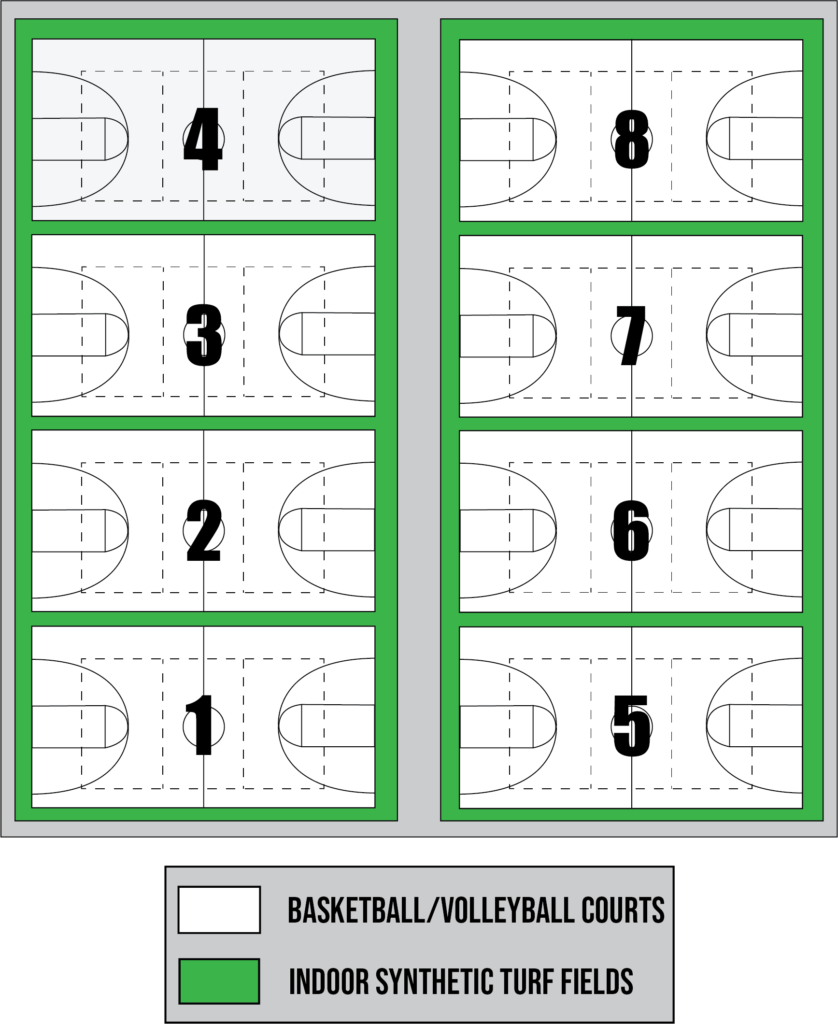
Image Source: mdsoccerplex.org
Basketball Courts on Football Fields: How Many Fit?
How many basketball courts fit on a football field? Typically, between 8 and 10 standard NBA-sized basketball courts can fit onto a regulation NCAA football field, depending on the exact dimensions used and the layout. This question often arises in discussions about maximizing space in multi-sport complex planning or when considering temporary venue setups. Let’s dive into the specifics.
Deciphering the Dimensions: Football Field vs. Basketball Court
To figure out how many basketball courts can occupy a football field, we first need to establish the standard measurements for both. These sports, while both popular, require vastly different playing areas.
Football Field Size
An American football pitch, particularly a NCAA football field, is a substantial rectangular area. Here are the key dimensions:
- Length: 120 yards (360 feet or approximately 109.7 meters). This includes the 100-yard playing field plus two 10-yard end zones.
- Width: 53.3 yards (160 feet or approximately 48.8 meters).
This gives us a total playing area of 120 yards x 53.3 yards, or 6,396 square yards. In feet, it’s 360 feet x 160 feet, totaling 57,600 square feet.
Basketball Court Dimensions
The size of a basketball court can vary slightly depending on the league or governing body, but for our comparison, we’ll use the most common professional and international standards.
- NBA Court Size: An NBA court size is 94 feet long by 50 feet wide. This is 4,700 square feet.
- Olympic Basketball Court: An Olympic basketball court (and FIBA standard) is slightly smaller: 28 meters long by 15 meters wide. This translates to approximately 91.9 feet long by 49.2 feet wide, totaling about 4,523 square feet.
For simplicity and common understanding, we’ll primarily use the NBA court dimensions for our calculations.
Calculating the Court to Field Ratio
Now, let’s do the math to see how many basketball courts can fit onto a football field. This involves comparing the total area and also considering practical layouts.
Area Comparison
First, let’s look at the pure area.
- Football Field Area: 57,600 square feet.
- NBA Basketball Court Area: 4,700 square feet.
If we were just dividing total area by total area, ignoring any required spacing or realistic arrangement:
57,600 sq ft (Football Field) / 4,700 sq ft (NBA Court) ≈ 12.25 courts.
However, this is a purely theoretical number. We need to consider how courts would actually be laid out.
Practical Layouts
When planning a multi-sport complex or a temporary event, sports facility planning requires thinking about access, safety zones around courts, and efficient use of space. We need to account for the length and width of both the field and the courts.
Let’s consider laying out NBA courts lengthwise along the football field.
- Football Field Length: 360 feet.
- NBA Court Length: 94 feet.
- Football Field Width: 160 feet.
- NBA Court Width: 50 feet.
Scenario 1: Laying out courts side-by-side along the length of the field.
- Along the length (360 feet): You can fit 360 feet / 94 feet per court ≈ 3.8 courts. Realistically, you can fit 3 full courts lengthwise, with some space remaining.
- Along the width (160 feet): You can fit 160 feet / 50 feet per court ≈ 3.2 courts. Realistically, you can fit 3 full courts widthwise.
If you lay them out in a grid:
- You could potentially fit 3 courts along the length and 3 courts along the width, totaling 3 x 3 = 9 courts.
- However, the remaining space along the length (360 – (3 * 94) = 360 – 282 = 78 feet) might be enough to squeeze in another row of courts if arranged differently, or if slightly narrower courts are used.
Scenario 2: Optimizing for maximum courts.
Let’s reconsider the width. If we place courts with their 94-foot length running across the 160-foot width of the field:
- Along the width (160 feet): You can fit 160 feet / 94 feet per court ≈ 1.7 courts. So, you can fit 1 full court this way, with significant space left over (160 – 94 = 66 feet).
- Along the length (360 feet): You can fit 360 feet / 50 feet per court ≈ 7.2 courts. So, you can fit 7 full courts lengthwise.
If we arrange them this way, you could fit 1 row of 7 courts, taking up 94 feet of the 160-foot width. The remaining 66 feet of width is not enough for another full 94-foot court.
Scenario 3: Considering buffer zones and specific layouts.
In real-world applications, especially for competitive play or events, you need space around each court for player movement, spectator viewing areas, and potentially equipment storage. For casual use or exhibition purposes, you might be able to pack them tighter.
If we assume each court requires a minimal buffer, say 10 feet on each side (lengthwise) and 5 feet on each end (widthwise) for basic operation:
- Effective NBA Court Size with buffer: (94 + 10 + 10) ft x (50 + 5 + 5) ft = 114 ft x 60 ft.
Now, let’s try to fit these larger effective areas onto the football field:
- Along the 360 ft length: 360 ft / 114 ft ≈ 3.15. So, 3 courts.
- Along the 160 ft width: 160 ft / 60 ft ≈ 2.66. So, 2 courts.
In this more realistic scenario, you could fit 3 x 2 = 6 courts. This is a much lower number but accounts for practical space.
However, if we consider a layout where courts are placed end-to-end along the field’s length, and then multiple rows are placed across the width:
- Lengthwise on the field: 360 ft.
- Widthwise on the field: 160 ft.
- NBA Court: 94 ft x 50 ft.
Let’s place the 50ft dimension of the court along the 160ft width of the field:
- Across the width (160 ft): You can fit 160 ft / 50 ft = 3.2 courts. Let’s say 3 courts fit, with some space. (3 * 50 = 150 ft used). This leaves 10 ft.
- Down the length (360 ft): You can fit 360 ft / 94 ft = 3.8 courts. Let’s say 3 courts fit. (3 * 94 = 282 ft used). This leaves 78 ft.
So, you could have 3 courts across the width and 3 courts along the length, forming a 3×3 grid, which is 9 courts. The remaining 78 ft of length could potentially accommodate another row of courts if they were shorter, or if the spacing was reduced.
Consider placing the 94ft dimension of the court along the 160ft width of the field:
- Across the width (160 ft): You can fit 160 ft / 94 ft = 1.7 courts. So, 1 court fits. (94 ft used). This leaves 66 ft.
- Down the length (360 ft): You can fit 360 ft / 50 ft = 7.2 courts. So, 7 courts fit. (7 * 50 = 350 ft used). This leaves 10 ft.
This layout gives us 1 row of 7 courts.
The most efficient way to pack them, assuming minimal but safe spacing, often leads to the higher numbers. The generally cited range of 8 to 10 courts assumes a layout where the 50-foot width of the court is aligned with the 160-foot width of the field, allowing for multiple rows.
Comparing Field and Court Areas in a Table
| Feature | Dimension (Feet) | Area (Sq Ft) |
|---|---|---|
| NCAA Football Field | 360 (L) x 160 (W) | 57,600 |
| NBA Basketball Court | 94 (L) x 50 (W) | 4,700 |
| Olympic/FIBA Court | ~91.9 (L) x ~49.2 (W) | ~4,523 |
Key Observations from the Table:
- A football field is significantly larger than a single basketball court.
- The width of the football field (160 ft) is just over three times the width of an NBA court (50 ft).
- The length of the football field (360 ft) is nearly four times the length of an NBA court (94 ft).
Factors Influencing the Number of Courts
Several variables determine the precise number of basketball courts you can fit on a football field.
Spacing and Safety Margins
This is perhaps the most critical factor.
- FIBA recommendations: Suggest a minimum of 2 meters (approx. 6.5 feet) of clear space behind each baseline and 1 meter (approx. 3.3 feet) on each side of the court.
- NBA standards: Often require more space, typically around 15-20 feet behind the baselines and 10-15 feet along the sidelines for professional play, broadcasting, and security.
- Temporary setups: For events or community use, these margins can be reduced, allowing more courts to be placed.
If we use the FIBA minimum spacing (roughly 21 feet total length, 13 feet total width per court):
- Effective NBA Court Size: (94 + 21) ft x (50 + 13) ft = 115 ft x 63 ft.
- Along 360 ft length: 360 ft / 115 ft ≈ 3.13 (3 courts)
- Along 160 ft width: 160 ft / 63 ft ≈ 2.54 (2 courts)
- Total: 3 x 2 = 6 courts. This aligns with the earlier calculation with generous buffers.
However, if we consider a layout where courts are placed adjacent to each other with minimal institutional spacing, and the football field’s dimensions are utilized efficiently:
Layout 1 (Courts oriented length-wise):
- Align the 50ft width of the basketball court with the 160ft width of the football field.
- You can fit 160 ft / 50 ft = 3.2 courts. Let’s say 3 courts, taking up 150 ft. This leaves 10 ft unused width.
- Align the 94ft length of the basketball court with the 360ft length of the football field.
- You can fit 360 ft / 94 ft = 3.8 courts. Let’s say 3 courts, taking up 282 ft. This leaves 78 ft unused length.
- This gives you 3 rows of 3 courts, totaling 9 courts. The remaining 78 ft of length could be used for a fourth row of courts if they are shorter, or if spacing is reduced in that direction.
Layout 2 (Courts oriented width-wise):
- Align the 94ft length of the basketball court with the 160ft width of the football field.
- You can fit 160 ft / 94 ft = 1.7 courts. Let’s say 1 court, taking up 94 ft. This leaves 66 ft unused width.
- Align the 50ft width of the basketball court with the 360ft length of the football field.
- You can fit 360 ft / 50 ft = 7.2 courts. Let’s say 7 courts, taking up 350 ft. This leaves 10 ft unused length.
- This layout gives you 1 row of 7 courts.
The common estimate of 8-10 courts usually comes from Layout 1, assuming that the remaining 78 feet of length can accommodate another partial row or that the 10 feet leftover width across 3 courts allows for some additional flexibility in placing another row. For example, if you could place 4 courts widthwise (requiring 4 * 50 = 200 ft), you would exceed the 160 ft width. However, if you optimize the spacing for 4 courts across the 160ft width, you might only have 40ft per court, which is too small.
A more realistic approach for 8-10 courts involves careful arrangement:
- Fit 3 courts along the 160ft width (3 x 50ft = 150ft, leaving 10ft).
- Along the 360ft length, fit 3 courts (3 x 94ft = 282ft, leaving 78ft).
- This gives 3×3 = 9 courts. The remaining 78ft of length is substantial. If you were to turn the orientation for the next “set” of courts, you could fit another row.
- Consider a 4×2 arrangement: 4 courts across the width (4 * 50ft = 200ft, too wide). 2 courts across the width (2 * 94ft = 188ft, still too wide).
- The 8-10 estimate likely involves fitting 3 courts side-by-side across the 160ft width (leaving 10ft). Then, along the 360ft length, fitting 3 full courts (282ft used). The remaining 78ft of length might be used for a fourth row of courts if their length is shortened or if the width spacing is compressed. Alternatively, it implies fitting 3 courts along the length and then multiple rows of courts across the width.
Let’s assume we fit 3 courts side-by-side across the 160ft width (using 150ft). Now, how many rows of these 3-court configurations can fit along the 360ft length? Each “3-court unit” would have a length of 94ft.
- 360 ft / 94 ft ≈ 3.8. So you can fit 3 full rows of 3 courts (3×3=9 courts).
- The remaining 78ft could potentially accommodate another partial row if the courts were oriented differently or if the spacing was extremely tight.
The number 8 to 10 is a good practical range, acknowledging that precise configurations matter.
Type of Basketball Court
- Full-size courts: As discussed, NBA or FIBA courts.
- Half-courts or smaller: For recreational use, you could fit many more smaller courts or practice areas. However, the question implies standard courts.
Usage and Accessibility
- Permanent installations: Require foundations, safety surfacing, and permanent markings.
- Temporary setups: Often seen at festivals or promotional events, these might use portable flooring and can be arranged more flexibly, potentially allowing for tighter packing but less durability.
Additional Amenities
If you need space for seating, scoreboards, first-aid stations, or entrances/exits, the number of courts will decrease.
Comparing to Other Sports Surfaces
It’s interesting to consider how this court to field ratio compares to other sports. For instance, an indoor soccer field is typically around 100 yards (300 feet) long by 60 yards (180 feet) wide, often with a smaller playing area than an outdoor American football pitch. An indoor soccer field would offer a very similar, if not slightly larger, area than an outdoor football field, allowing for a similar number of basketball courts.
A standard soccer field used for international matches (FIFA) is:
- Length: 100 to 130 yards (300 to 390 feet)
- Width: 50 to 100 yards (150 to 300 feet)
A typical FIFA pitch might be around 110 yards x 70 yards (330 ft x 210 ft).
Let’s use a common FIFA size of 330 ft x 210 ft for comparison:
- Football Field (NCAA): 360 ft x 160 ft
- Soccer Field (FIFA): 330 ft x 210 ft
Fitting NBA courts (94 ft x 50 ft) on a FIFA field:
- Layout 1 (50ft width along 210ft width):
- 210 ft / 50 ft = 4.2 (4 courts fit)
- 330 ft / 94 ft = 3.5 (3 courts fit)
- Total: 4 x 3 = 12 courts.
This indicates that a wider soccer field might actually accommodate more basketball courts than a narrower football field, given the optimal orientation of the courts.
Maximizing Space in Multi-Sport Facilities
The concept of fitting basketball courts onto football fields highlights the challenges and ingenuity involved in sports facility planning, especially for multi-sport complexes. Such complexes aim to cater to diverse athletic needs within a limited footprint.
Considerations for such planning include:
- Shared infrastructure: Utilizing common seating areas, restrooms, and parking.
- Convertible spaces: Some venues might be designed to reconfigure their layout, perhaps with retractable seating or modular flooring, to accommodate different sports.
- Outdoor to indoor: While football fields are outdoors, basketball courts are often indoors. This comparison implies either covering a football field or using it as an outdoor venue, which is less common for professional basketball but possible for recreational or temporary events. Many larger sports complexes might have an outdoor football stadium and adjacent indoor arenas housing basketball courts. The question is more about the area equivalence.
Practical Examples and Scenarios
When might this scenario actually occur?
- Major Sporting Events: During events like the Olympics or large multi-sport festivals, temporary venues are often erected. A large open space like a football stadium’s pitch could be repurposed.
- Community Festivals: Local parks or school grounds with football fields might be transformed for community sports days, featuring temporary basketball courts.
- Exhibition Games: Occasionally, outdoor basketball games might be held in large stadiums, using the field as the base.
- Conceptual Planning: Architects and planners designing new sports facilities might compare the spatial requirements of different sports to understand how they can be integrated effectively.
Imagine a large convention center or exhibition hall that might be used for various events. If the hall’s dimensions are comparable to a football field, planners might consider how many basketball courts could be set up within that space.
Frequently Asked Questions (FAQ)
Q1: Can you really play basketball on a football field?
Yes, you can set up basketball courts on a football field. This is typically done for temporary events, recreational use, or as part of larger multi-sport festivals where space needs to be maximized. Professional or official basketball games are almost exclusively played on dedicated indoor courts.
Q2: What is the difference between an NBA court and an Olympic basketball court?
An NBA court is 94 feet by 50 feet. An Olympic or FIBA court is 28 meters by 15 meters, which is approximately 91.9 feet by 49.2 feet. The NBA court is slightly larger.
Q3: Does the end zone of a football field count in the dimensions?
Yes, when referring to the total playing area of a football field, the two 10-yard end zones are included in the length. So, a 100-yard field plus two 10-yard end zones makes for a 120-yard total length.
Q4: How much space is needed around a basketball court?
The amount of space required around a basketball court varies. FIBA recommends a minimum of 2 meters behind baselines and 1 meter on the sides. Professional leagues like the NBA often require significantly more space, around 15-20 feet behind baselines and 10-15 feet on the sidelines, for safety, player movement, and operational needs.
Q5: Could you fit more courts if you used smaller, non-regulation sizes?
Absolutely. If you were setting up recreational or practice areas, you could mark out smaller courts or half-courts. In such a scenario, you could fit many more basketball playing areas onto a football field. The calculation of 8-10 courts assumes full, regulation-sized NBA or FIBA courts.
Q6: Is it common for football stadiums to host basketball games?
It’s not common for regular season or championship basketball games to be held in football stadiums due to the different requirements of the sports (indoor vs. outdoor, court surface, seating arrangements). However, exhibition games, All-Star events, or special community events might occasionally utilize large stadiums for basketball.
In conclusion, while a football field offers a vast expanse of space, efficiently fitting multiple regulation basketball courts requires careful spatial planning and consideration of critical factors like spacing, court orientation, and the specific dimensions of the courts being used. The estimate of 8 to 10 full-sized basketball courts provides a practical benchmark for this intriguing spatial question.